
Comics, Episodes, Characters, Thinking Styles
Brainstorm with guidelines; Find truly new opportunities

My former partner at Adaptive Path, Peter Merholz, had a phrase he liked to say when we had helped a client see from a new perspective.
“We popped their head off then put it on backwards.”
Yes, kinda gory. But. This perspective shift is incredibly important in our brainstorming sessions, or when arguing with stakeholders who ask you to implement a lousy idea of theirs.
New perspectives from the point of view of the cognition of the people you intend to support produce truly new ideas. We constrain teams to avoid trying to change someone’s cognition. This constraint helps the team get out of the rut of thinking of solutions using existing technology paths: phones, social, ads, ai, etc.
Here’s a comic about how a team uses characters, episodes, and thinking styles to set the stage for a brainstorming session, and the novel idea that comes out of it.
Here is a post on LinkedIn that you can like or repost. In addition to this comic, it also contains links to a video, an essay, and a course.
There was a time when teams would invent personas out of thin air, and researchers would get upset because there were no data patterns being represented. They would say, “You can’t just invent personas.”
But what teams were doing was inventing characters. That’s not wrong. But it’s not enough.
What was missing were the relationships between the characters so that they could be used to tell many stories—the episodes.
The other thing that was missing was the purpose/goal the characters were pursuing. Teams would just write scenarios and journey maps without identifying the purpose/goal the character had. It was implied that the purpose/goal was to “use/experience the solution.” The team was navel gazing.
And yet one more huge thing that was missing were the “hats” the characters would wear in the episodes. People do not all approach the same purpose/goal with the same cognition. There is a small variety of thinking styles when it comes to any one purpose/goal.
How To Do This With Your Team
Guiding your brainstorming sessions with structure really changes what comes out of the collaboration. Structure your idea sessions with:
the purpose/goal your org intents to support
a cast of characters, just like in a TV series
a story written as an episode
highlights of thinking style variety
Push back against ideas from others (ideas that don’t meet these criteria) with this same approach.
🥰 If you enjoy my newsletter, you can now contribute $1 a month. Or 80 cents. Or 50 cents — the lowest bank threshold. (None of this money goes to Substack or LinkedIn or Medium, or any of those platforms. Nope.)
(To cancel your contribution at any time, reach out to me via indiyoung.com)
Description of Comic Panels
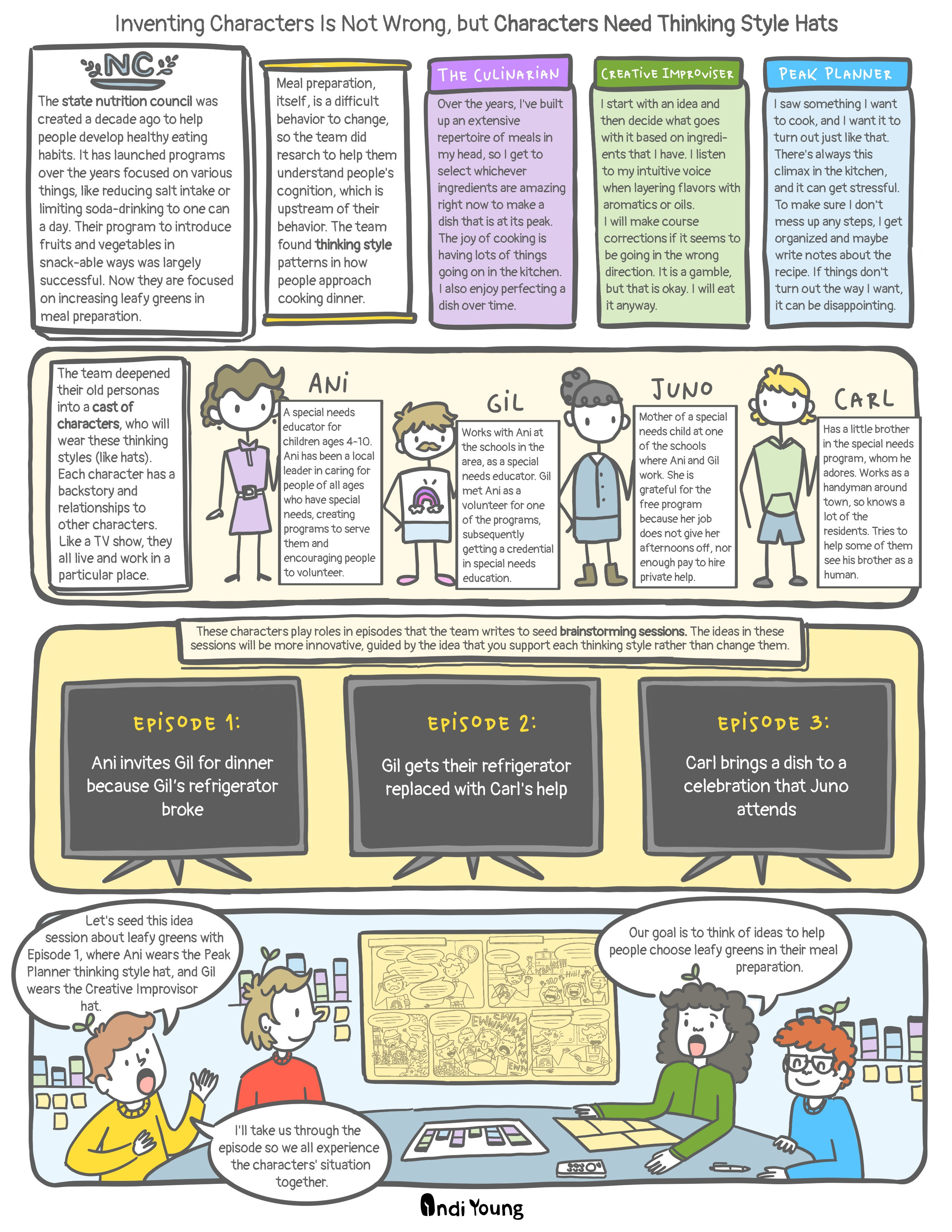
Title: Inventing Characters Is Not Wrong, but Characters Need Thinking Style Hats
Block Paragraph 1:
The state nutrition council was created a decade ago to help people develop healthy eating habits. It has launched programs over the years focused on various things, like reducing salt intake or limiting soda-drinking to one can a day. Their program to introduce fruits and vegetables in snack-able ways was largely successful. Now they are focused on increasing leafy greens in meal preparation.
Block Paragraph 2:
Meal preparation, itself, is a difficult behavior to change, so the team did research to help them understand people’s cognition, which is upstream of their behavior. The team found thinking style patterns in how people approach cooking dinner.
The three thinking styles:
The Culinarian
Over the years, I’ve built up an extensive repertoire of meals in my head, so I get to select whichever ingredients are amazing right now to make a dish that is at its peak.
The joy of cooking is having lots of things going on in the kitchen. I also enjoy perfecting a dish over time.
Creative Improviser
I start with an idea and then decide what goes with it based on ingredients that I have. I listen to my intuitive voice when layering flavors with aromatics or oils.
I will make course corrections if it seems to be going in the wrong direction. It is a gamble, but that is okay. I will eat it anyway.
Peak Planner
I saw something I want to cook, and I want it to turn out just like that.
There’s always this climax in the kitchen, and it can get stressful. To make sure I don’t mess up any steps, I get organized and maybe write notes about the recipe. If things don’t turn out the way I want, it can be disappointing.
Block Paragraph 3:
The team deepened their old personas into a cast of characters, who will wear these thinking styles (like hats). Each character has a backstory and relationships to other characters. Like a TV show, they all live and work in a particular place.
The four characters:
Ani
A special needs educator for children ages 4-10. Ani has been a local leader in caring for people of all ages who have special needs, creating programs to serve them and encouraging people to volunteer.
Gil
Works with Ani at the schools in the area, as a special needs educator. Gil met Ani as a volunteer for one of the programs, subsequently getting a credential in special needs education.
Juno
Mother of a special needs child at one of the schools where Ani and Gil work. She is grateful for the free program because her job does not give her afternoons off, nor enough pay to hire private help.
Carl
Has a little brother in the special needs program, whom he adores. Works as a handyman around town, so knows a lot of the residents. Tries to help some of them see his brother as a human.
Block Paragraph 4:
These characters play roles in episodes that the team writes to seed brainstorming sessions. The ideas in these sessions will be more innovative, guided by the idea that you support each thinking style rather than change them.
Some of the episodes:
Episode 1:
Ani invites Gil for dinner because Gil’s refrigerator broke
Episode 2:
Gil gets their refrigerator replaced with Carl’s help
Episode 3:
Carl brings a dish to a celebration that Juno attends
Team Scene 1:
The brainstorming team sitting around a table in a room with the Gil/Ani comic printed out on the table or showing on a big screen, three skylines on different parts of the walls with stickies around them.
Speech Balloons:
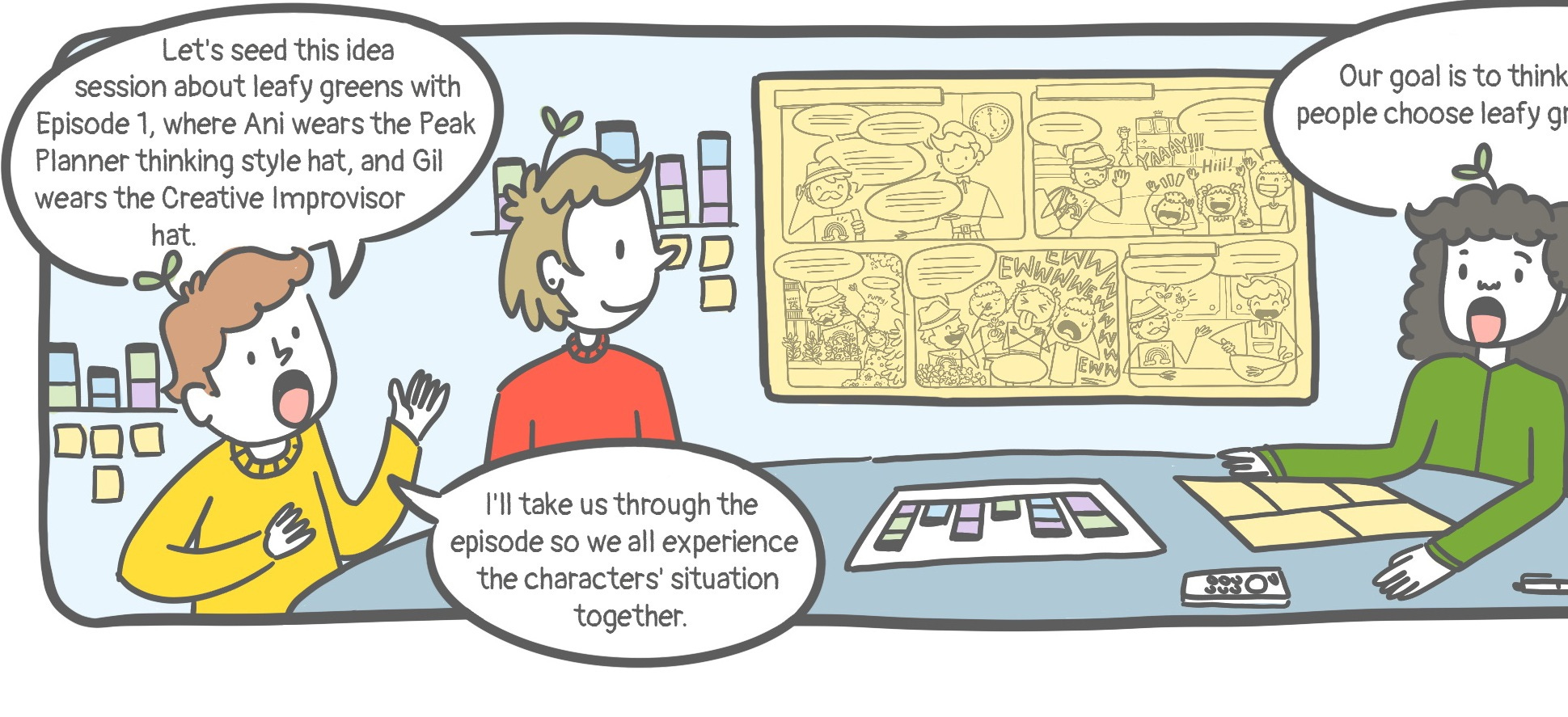
Team Member A: Let’s seed this idea session about leafy greens with Episode 1, where Ani wears the Peak Planner thinking style hat, and Gil wears the Creative Improvisor hat.
Team Member B: Our goal is to think of ideas to help people choose leafy greens in their meal preparation.
Team Member A: I’ll take us through the episode so we all experience the characters’ situation together.
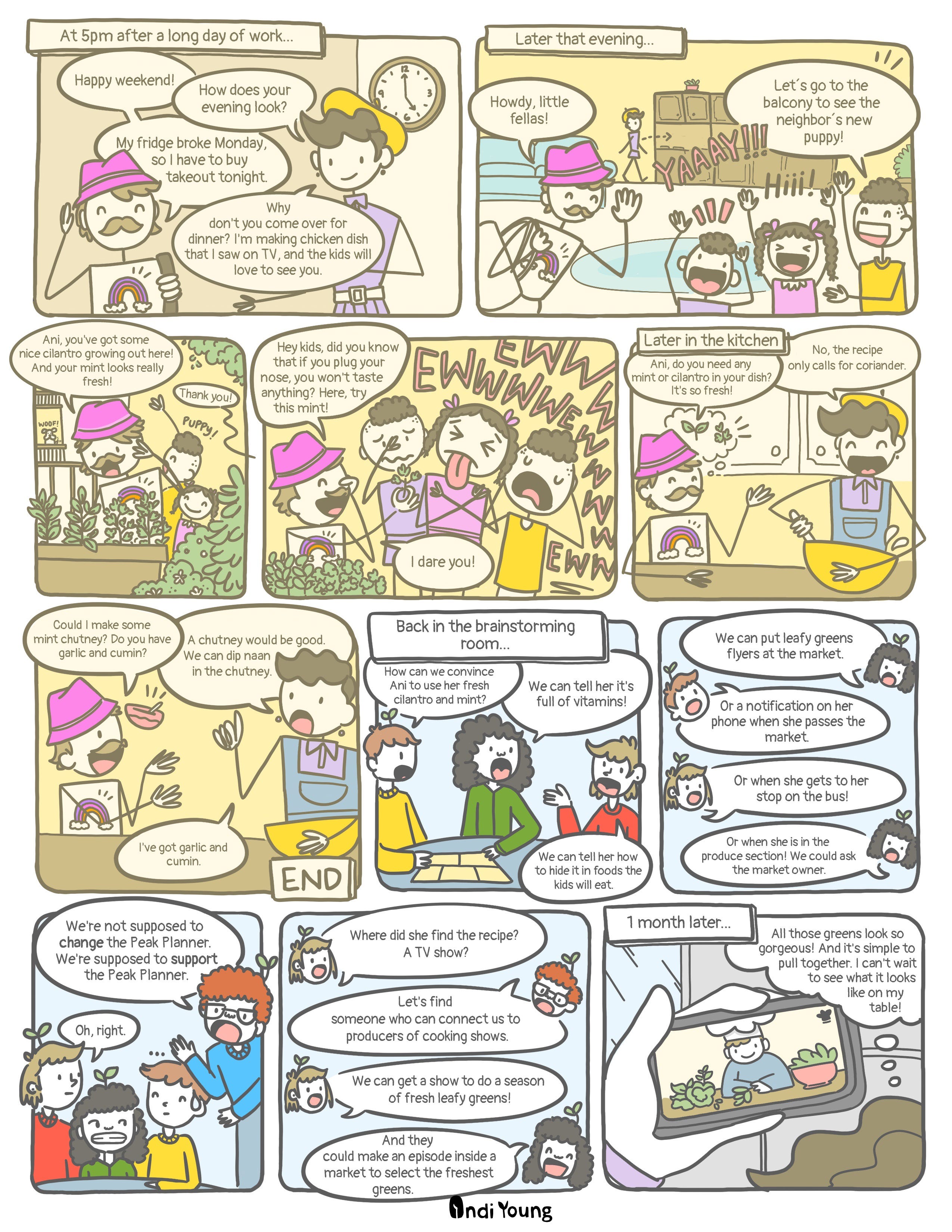
Episode 1 Scene 1: [start episode]
Ani and Gil exiting a grade school at 5pm, after working with special needs kids all afternoon. They are chatting as they walk out.
Speech Balloons:
Gil: Happy weekend!
Ani: How does your evening look?
Gil: My fridge broke Monday, so I have to buy takeout tonight.
Ani: Why don’t you come over for dinner? I’m making chicken dish that I saw on TV, and the kids will love to see you.
Episode 1 Scene 2:
The apartment, kids greeting Gil and urging them out to the balcony to see the new puppy that the neighbor has<Greetings among everyone, excited kids, Ani is heading to the kitchen and Gil is greeting the kids>
Episode 1 Scene 3:
On the balcony, edibles are growing everywhere, along with flowers. Maybe the kids are looking across to the other balcony with a puppy on it that they want to show Gil.
Speech Balloons:
Gil: Ani, you’ve got some nice cilantro growing out here! And your mint looks really fresh!
Ani: Thank you!
Episode 1 Scene 4:
Gil on the balcony with the kids. Ani is inside at the counter in the kitchen getting ingredients out and her recipe notes.
Speech Balloons:
Gil: Hey kids, did you know that if you plug your nose, you won’t taste anything? Here, try this mint!
Kids: Ewww! <in various forms>
Gil: I dare you! <laughing as one kid plugs their nose and their eyes get round, surprised>
Episode 1 Scene 5:
Gil talking to Ani in the kitchen
Speech Balloons:
Gil: Ani, do you need any mint or cilantro in your dish? It’s so fresh!
Ani: No, the recipe only calls for coriander.
Gil: (thought bubble picture of cilantro next to coriander, the seeds of cilantro)
Episode 1 Scene 6:
Gil talking to Ani in the kitchen
Speech Balloons:
Gil: Could I make some mint chutney? Do you have garlic and cumin?
Ani: A chutney would be good. We can dip naan in the chutney. I’ve got garlic and cumin.
[end episode]
Team Scene 2:
The team starts energetically coming up with ideas in the room. Team Member D looks a little incredulous.
Speech Balloons:
Team Member A: How can we convince Ani to use her fresh cilantro and mint?
Team Member B: We can tell her it’s full of vitamins!
Team Member C: We can tell her how to hide it in foods the kids will eat.
Team Scene 3:
The team continues coming up with ideas, feeling especially excited about the phone notifications.
Speech Balloons:
Team Member B: We can put leafy greens flyers at the market.
Team Member A: Or a notification on her phone when she passes the market.
Team Member C: Or when she gets to her stop on the bus!
Team Member A: Or when she is in the produce section! We could ask the market owner.
Team Scene 4:
Team Member D finally gets the attention of the others.
Speech Balloons:
Team Member D: No. We’re not supposed to change the Peak Planner. We’re supposed to support the Peak Planner.
Team Member C: Oh, right.
Team Member B: <embarrassed grin with hand in front of mouth, eyes to side>
Team Member A: <some sort of facial reaction>
[this is the key turning point of this example, the key lesson]
Team Scene 5:
The ideas now are going to be supportive of the Payoff Planner. Team members have a calmer, more confident energy.
Speech Balloons:
Team Member C: Where did she find the recipe? A TV show?
Team Member D: Let’s find someone who can connect us to producers of cooking shows.
Team Member C: We can get a show to do a season of fresh leafy greens!
Team Member B: And they could make an episode inside a market to select the freshest greens.
Episode 1 Scene 7:
A month later, Ani is watching her favorite cooking show on her phone on the bus. It shows the chef with several bowls/bundles of different leafy greens, explaining how they all come together in the dishes of this meal.
Thought bubble:
Ani: All those greens look so gorgeous! And it’s simple to pull together. I can’t wait to see what it looks like on my table!
[end comic]