
This Method: Name & Positioning
A status report, plus some questions for you

🌱 Interested in Live Practice for Listening Deeply? What dates might work for you?

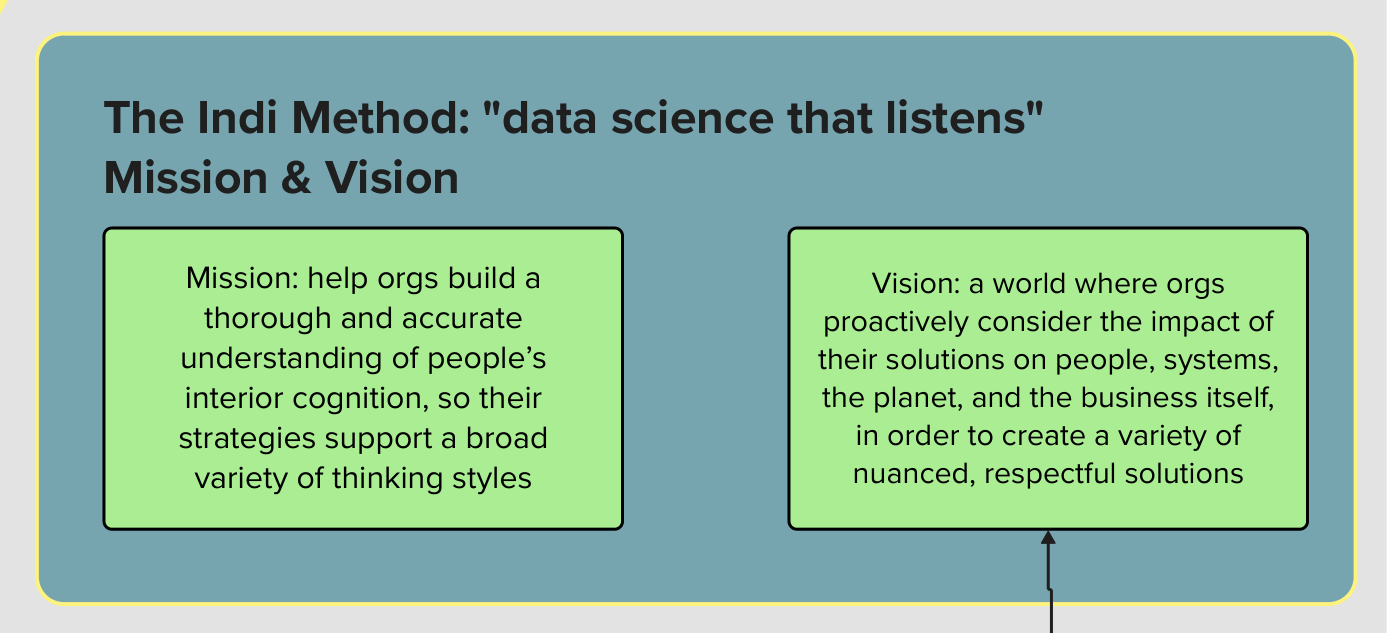
It has been a month, and I have some progress to show you. We have not chosen a name yet, but we have created really clear positioning and values for The Method. I feel excited to finally understand how to look at The Method from the perspective of someone who gets direct value from it!
Here are the concepts, in visual format. I’d love comments! (Link to Mural board is on the IndiYoung Slack Workspace.)
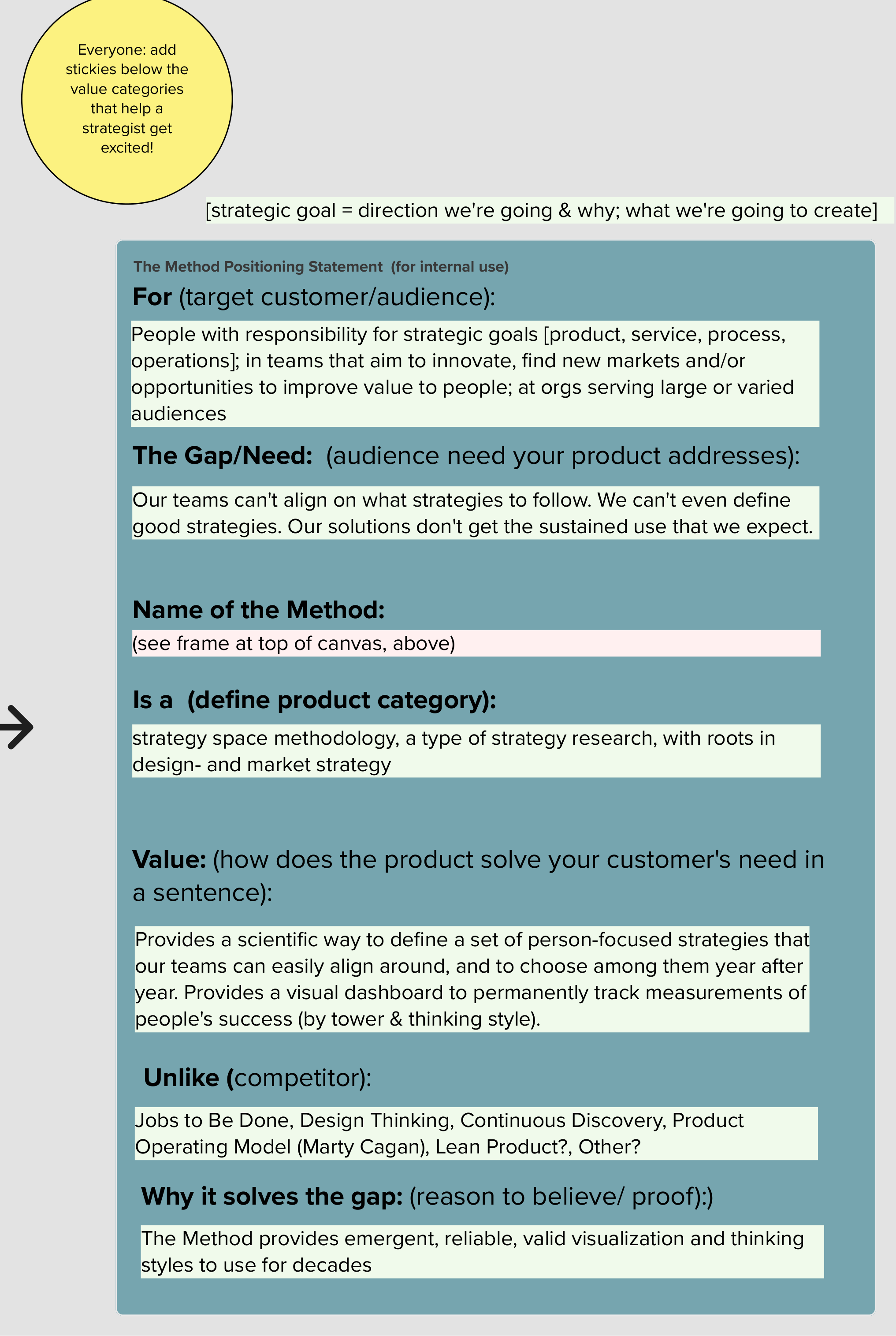
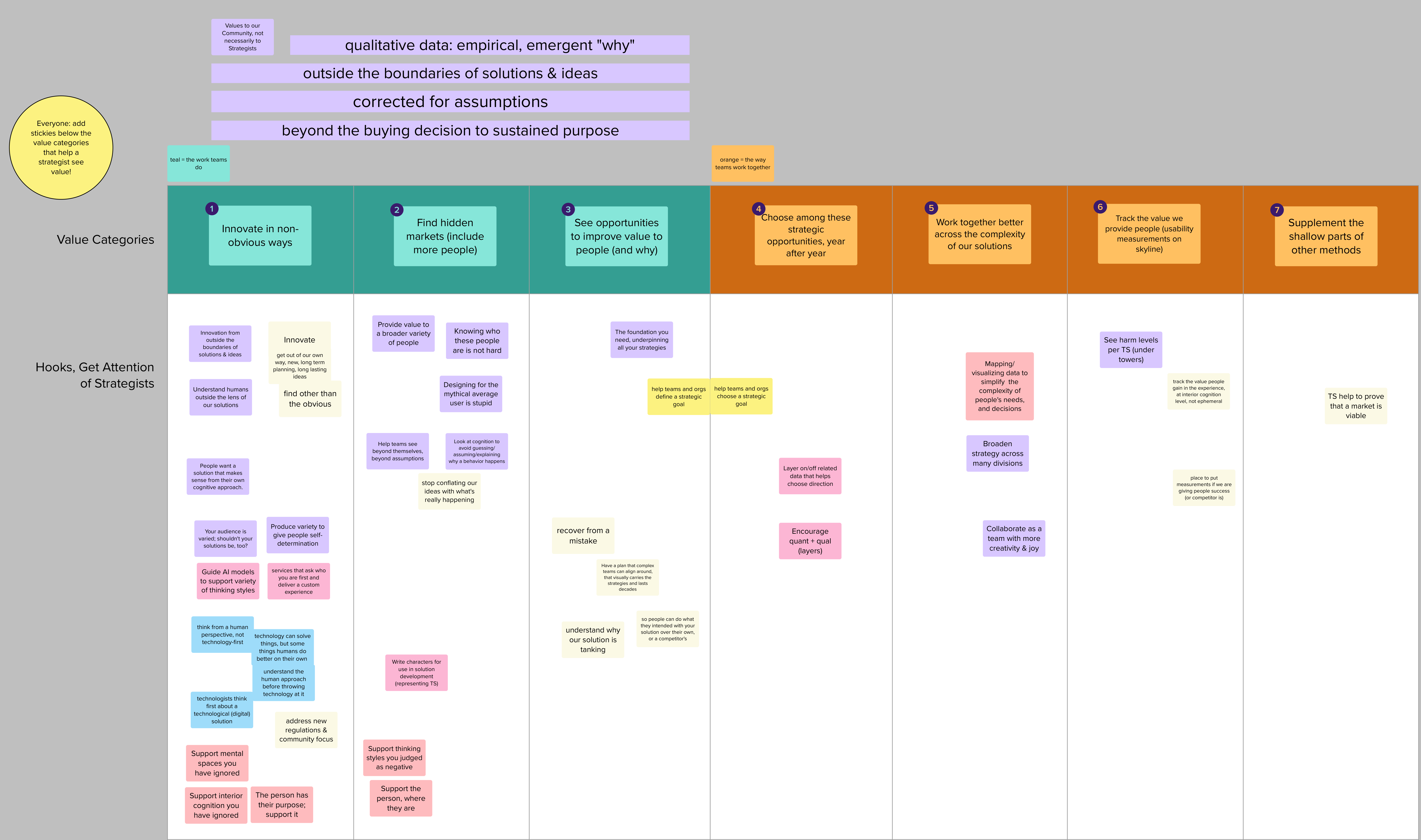
Here are the seven “values for people setting strategic goals” that emerged from all the data, comments, podcasts, books, and talks I was taking in over the past month. I made them into a table and started putting the “hooks to get attention of strategists” in stickies below each value. The seven values are divided into two groups, one (in teal, on the left) representing the work a team does with the knowledge, and the other (in orange, on the right) representing the way teams can work together using the artefacts. Oh, and there’s a third group (lavender, above the table) that represents things that are of value to us, in the community, but not necessarily to strategists.
Innovate in non-obvious ways
Find hidden markets (include more people)
See opportunities to improve value to people (and why)
Choose among these strategic opportunities, year after year
Work together better across the complexity of our solutions
track the value we provide people (usability measurements layered on the diagram)
Supplement the “shallow” parts of other methods (how to say that without being judgmental?)
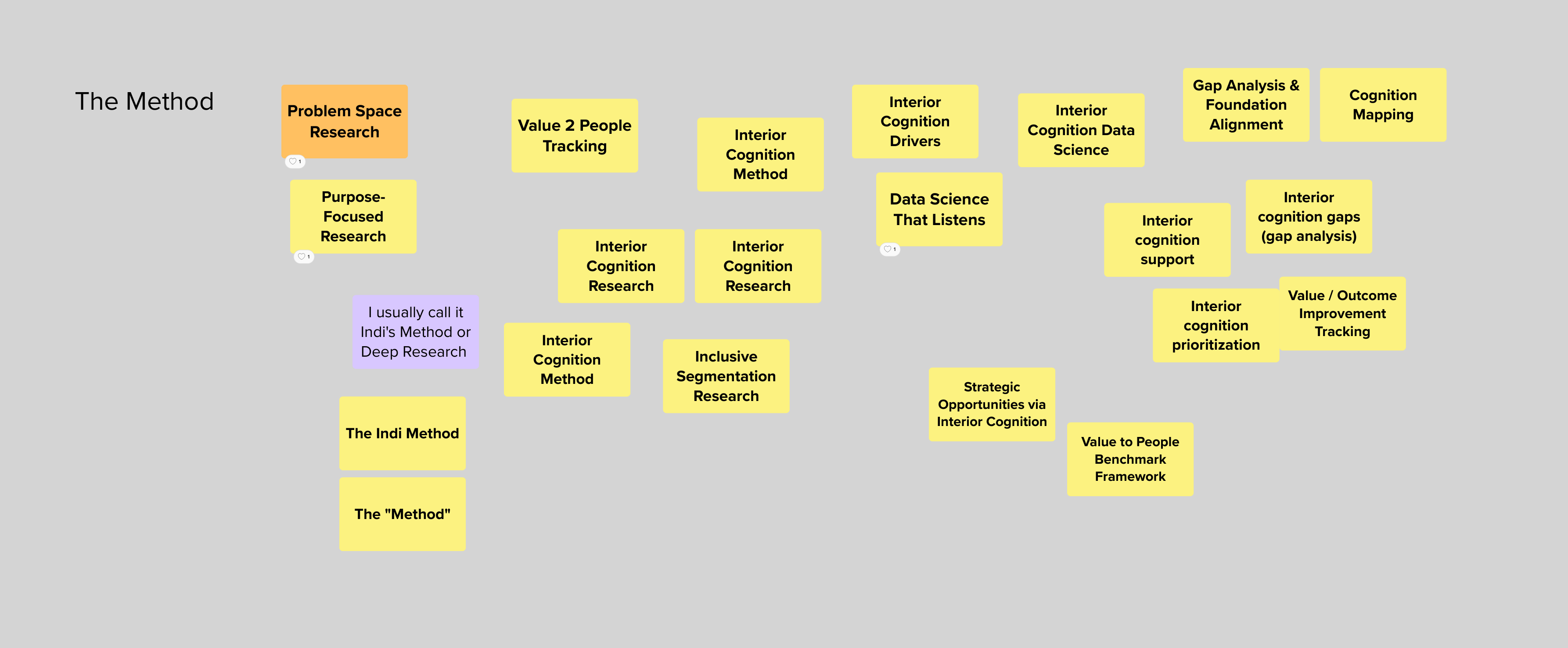
A Name
“Data Science that Listens” is my placeholder for the name of the method. We are playing with some ideas in sticky-note form on the same Mural Board. Because the phrase “problem space” has varying meanings, we need something else. “Problem space” is associated by half the field with “waterfall” style requirements documents, where collaborating together is preferred. I have heard from folks that they just refer to the method as “Indi’s Method,” and possibly that is … not descriptive, arrogant, not showing that the method belongs to the community and is adapted in many ways. So, here’s an image of what we have on the board. Comments welcome!
I think it is important for us to show we are not usability folks, not user experience of a solution or an idea. That is Solution Space work.
Instead we produce a type of strategy, direction, foundation for choosing strategic goals that is different than traditional business. It centers the humans, of course, using qualitative data to see the "why" of what direction to go. This last sentence causes many strategy folks to feel distrust and turn away, back to methods that feel safe and proven. So we need a way to attract attention in a way that feels safe and proven. In a method name. Heh, not much to ask, right? 😆
There are also naming clusters for the diagram and for the thinking styles. (I don’t think the thinking styles need renaming, but it’s there just in case others do.) Under the diagram names there is “dashboard” because teams use the diagram for years to layer data on/off, and to track help/harm below each tower/cluster by thinking style. So it’s not a dashboard in the way of quant dashboards that automatically show the latest data. It’d more of a manual dashboard, which will sound ridiculous. Heh. Anyway.
Thank you for your input and help with this! I feel confident that we can do it, and that the future will be full of strategic goals that help teams and orgs be superstars in their support for a broad variety of thinking styles, inner thinking, emotional reactions, and personal rules/guiding principles. ❤️
—indi
Hi Indi. Thanks for sharing. Do you invite people from here to your Slack?