
Where Do Ideas Come From?
... when you are not solving your own experiences

You know the Double Diamond—the way the UK Design Council explained 20 years ago how innovation works? It’s a process diagram with two diamonds, one after the other, showing that design starts with an expanding Discovery phase followed by a converging Definition phase. Remember in 2019 when Erick Mohr presented his visualization at UX New Zealand about how many people are employed in New Zealand in each half of the two diamonds? It got a laugh..
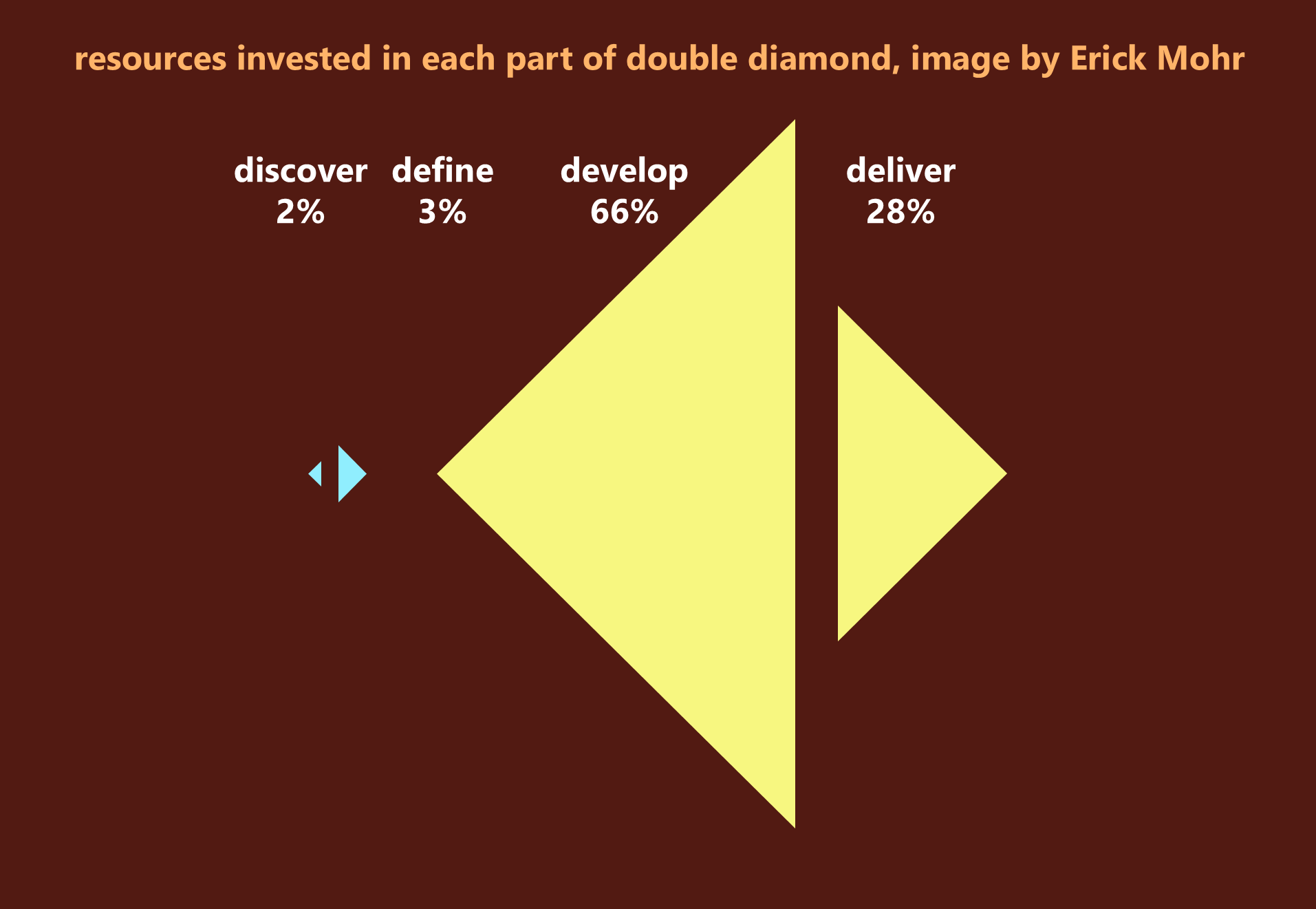
His point was that we can learn how to use Design as a strategic tool and improve the success of our organizations, and the success of the people our solutions support .
Four years later, Andy Budd published his Smashing Magazine article Improving the Double Diamond Design Process. His point was, “It’s just not the way most companies deliver new projects or services … if you’ve found yourself constantly pushing against a locked door, this approach might help you find a door that’s been left slightly ajar.” The article goes on to say, “While the double diamond concept is a wonderful model, it’s also largely a fantasy. … ‘customer discovery’ is often more about finding evidence to back up the assertion that this is the right thing to build rather than potentially discovering that it’s the wrong thing to build.” He introduces the Reverse Double Diamond.
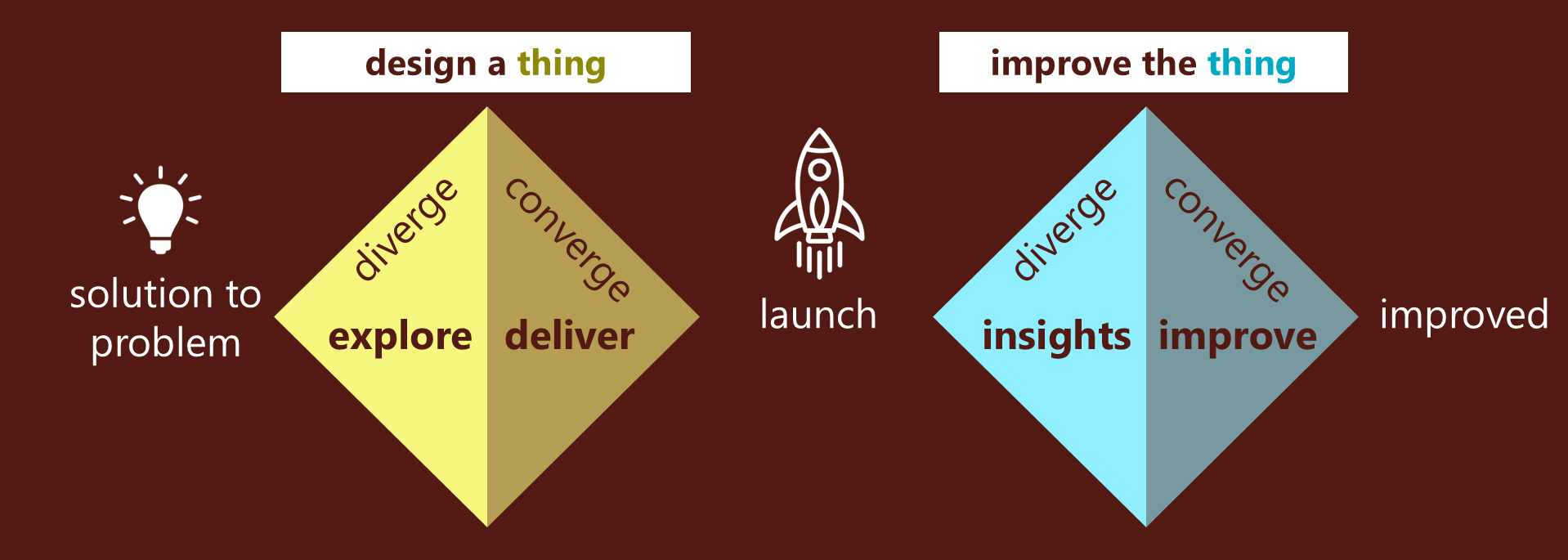
He advises readers to accept the way things are, and attempt to open the door during the Insights and Improve cycle—by actively monitoring how the new feature performs and “making a business case” to “extract more value” from the thing that launched. At this point, the stakeholder will be more open to it. Although, improvements won’t include the wildly different paths that could have been … no worries. If you’re confident that you won’t be laid off for a few years, you can iterate your team back toward the original Double Diamond and save your organization from wasted time and launched duds.
Well, now I’m also offering a change to the Double Diamond, building on what Erick and Andy have done. 😆 I want to change the first word. Discovery could mean “I discovered a solution!” It gets misinterpreted by people in a hurry (or being coerced to hurry) toward profit.* Let’s change Discovery to Absorb.
Discovery → Absorb
You know that word “dog-fooding?” It means asking every member of your organization has to actually eat (use) the dogfood (solution) that you produce. I don’t think anyone does this anymore, because the dry quality of most “dogfood” would be noticeable immediately. It’s like cardboard. It has no hydration.
How do you get hydration? Let me start at the root. Hang with me for the next four short paragraphs.
1. Imagination is really key to generating ideas. And imagination is fed by knowledge. It needs to be fed by knowledge when you are trying to solve for situations outside your own experience.** It’s fed by knowing what things people are already half-solving. When someone is half-solving something, it already exists in their mind. So the team’s imagination is fed by saturating itself in what was happening in people’s minds as they half-solved their something.
2. How do we find out what exists in people’s minds? Listening. (You knew I was going to say that, right? 😁)
3. Listening sessions are one of us sitting down and listening to someone to find out their cognition, what went through their mind as they were doing something in particular. Their inner thinking, emotional reactions, and personal rules that exist in people’s minds.
4. Have listening sessions with a lot of people doing the same particular thing. Then a team can help patterns emerge from this cognition, and these patterns provide the hydration for imagining ideas outside of your own experience.
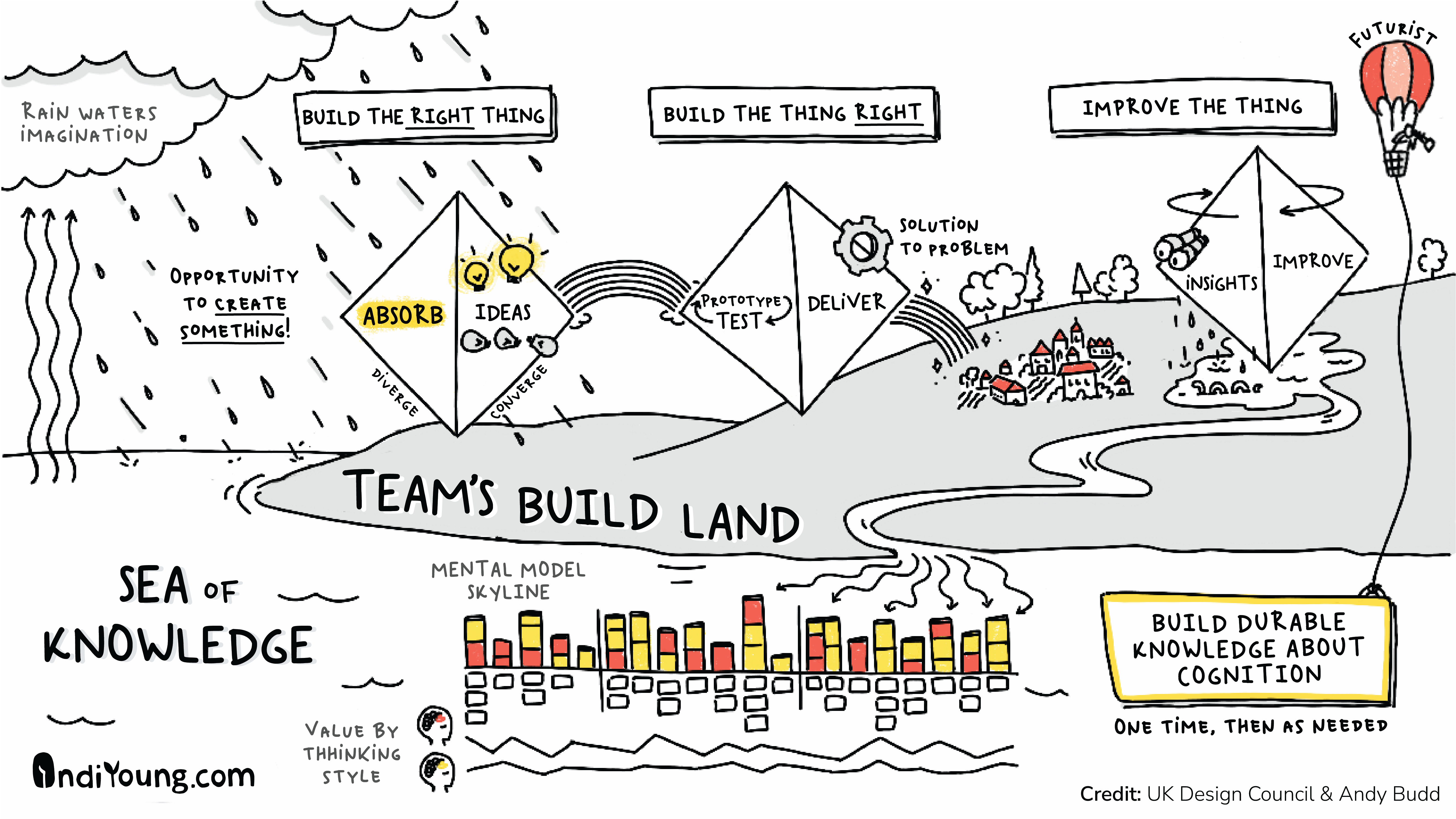
We focus on people’s cognition, create knowledge that lasts, and help teams creating products, services, policies, and programs to make strategic choices. This is a strategic cycle, going back to the point Erick Mohr was making.
So, here is the triple diamond water cycle. 🌧️🌈 I want to help the team absorb people’s cognition quickly. It is knowledge was already made for your team by a group working outside of the design process. It’s knowledge that is durable and gets created once, not as a part of the diamonds process. The group that creates this knowledge goes deep. They take a couple of months, but the resulting durable knowledge can quickly drench the team when they need it for ideation. And they can maintain the perspective of other people for this step, meaning that they can bring everyone into the way they imagine the future.
I am happy to hear feedback, thoughts, ideas.
*Yes, there are teams that don’t hurry toward profit. They measure “how much better is a person’s outcome.” Let me provide some examples: healthcare, civic functions, policy design, community programs, etc.
**Is this why teams mostly solve problems for people with privilege?